

AI for Business Development is no longer optional—it’s a competitive advantage. Modern leaders and teams are weaving AI into the fabric of daily work, not as a distant promise, but as a practical driver of results. According to Boston Consulting Group’s latest global survey, executives and managers are using generative AI several times a week, and half of companies are moving beyond basic productivity gains to completely redesign how work gets done.
Yet, the journey isn’t just about access to tools. The real transformation happens when business development leaders reshape workflows, invest in upskilling, and provide strong leadership support. In organizations where leaders champion AI, the percentage of employees who feel positive about AI rises dramatically (from 15% to 55%), and teams not only adapt—they thrive.
AI is to business development what GPS is to drivers; turning complexity into clarity, guesswork into strategy, and potential into measurable results.
AI Adoption & Impact
AI-powered tools now underpin the workflows of agencies, sales teams, and proposal managers across industries. The statistics are compelling, but what matters most is how these trends play out in real business scenarios—where AI-driven strategies turn bottlenecks into breakthroughs, and manual work into measurable results.

Below, you’ll find key industry insights, each paired with a practical, real-world scenario.
|
Key Insight & Source
|
Scenario Example
|
|---|---|
|
Over half of companies are redesigning workflows with AI; strong leadership support boosts employee positivity about AI from 15% to 55%.
|
A global firm launches an AI coaching initiative, and suddenly, frontline employees not only use GenAI tools daily—they actively advocate for more AI integration to speed up project delivery.
|
|
91% of U.S. ad agencies are using or exploring generative AI.
|
A mid-sized agency automates its campaign brief creation, freeing strategists to focus on winning new clients rather than chasing paperwork.
|
|
68% of proposal teams used generative AI in the past 12 months (2x YoY).
|
A proposal manager uses AI to instantly draft tailored RFP responses, allowing her team to submit twice as many high-quality proposals in half the time.
|
|
Gen AI tool built in 7 weeks, with input from 30+ sellers, 20+ data feeds.
|
A B2B sales org rapidly deploys a custom AI assistant that consolidates market data and sales insights, empowering reps to anticipate client needs in real time.
|
|
Up to 70% time savings on RFPs with AI/NLP.
|
A business development director leverages AI to auto-fill standard RFP answers, so her team can focus on customizing the win themes that seal the deal.
|
|
Over 2 million opportunities/month closed using AI sales tools.
|
An enterprise sales team relies on AI-powered deal scoring to prioritize outreach, resulting in higher close rates and less time wasted on low-probability leads.
|
Strategic Market Analysis: AI as Your Competitive Compass
In business development, understanding your market—customers, competitors, and trends—has always been vital. Traditionally, this meant hours (or days) spent digging through spreadsheets, hunting for up-to-date reports, and manually compiling insights from scattered sources. This process is not only slow, but it’s also easy to miss key opportunities or react too late.
AI upends this entire workflow. Instead of working by hand, imagine you’re using a high-powered metal detector: AI scans massive volumes of data in real time, instantly surfacing patterns, risks, and new opportunities that no human team could find at the same speed or scale.
How AI Changes the Game for Business Development Leaders
AI tools can automatically:
- Aggregate external news, competitor moves, and market signals alongside your internal data.
- Highlight emerging trends or untapped markets before your competitors even notice.
- Deliver actionable intelligence to your team in minutes, not weeks.
Real-World Example:
Take Sembly AI as a case in point. Sembly AI blends machine learning and natural language processing to help companies not only gather vast amounts of market data, but actually turn it into sharp, actionable insights. Teams use Sembly AI to spot white-space opportunities, pinpoint competitor blind spots, and extract real-time demand signals. With features like Semblian 2.0, it goes even further—helping marketers refine their brand messaging, optimize campaign timing, and auto-generate strategic documents such as content calendars and SEO reports. This means strategy teams aren’t just collecting data—they’re actually acting on it, faster and with greater confidence than ever before.
Manual vs. AI-Driven Market Analysis
|
Criteria
|
Manual Approach
|
AI-Driven Approach
|
|---|---|---|
|
Speed
|
Days/weeks
|
Minutes/hours
|
|
Data Sources
|
Limited, siloed
|
Dozens—internal & external
|
|
Accuracy
|
Prone to error
|
High (cross-validated, real-time)
|
|
Insights
|
Lagging, reactive
|
Predictive, proactive
|
Takeaway:
With AI, strategic market analysis becomes a real-time, proactive process—giving business development teams a true competitive edge. You’re not just reacting to the market, you’re anticipating it.

Personalized Lead Management
Lead qualification and outreach have long been time-consuming headaches for business development teams. Traditionally, scoring and prioritizing leads involved endless manual data analysis—leaving plenty of room for missed opportunities. AI automates and improves this process dramatically—and now plays a critical role in nurturing leads and supporting long-term client retention.
AI-Driven Lead Qualification
AI platforms analyze CRM data, behavioral signals, and purchase intent to rank leads smarter and faster. This means your best prospects don’t slip through the cracks, and your team focuses energy where it counts.
How AI Improves Lead Quality
AI doesn’t just automate lead generation—it dramatically improves the quality of leads your team works with. By using advanced algorithms to analyze customer data, behaviors, and preferences, AI ensures that your leads are highly relevant and more likely to convert. Instead of chasing every prospect, your team can focus on those with genuine interest and intent, leading to higher conversion rates and less wasted effort.
“By identifying patterns and intent, AI targets the right audience with precision, reducing wasted effort on unqualified prospects.”
– Intent Amplify®, 2024
Tailored Messaging at Scale
AI also excels at crafting personalized messaging. For instance, tools like Aurora Slides analyze business needs and past interactions to generate tailored pitches. Higher Engagement Rates: BuzzBoard reports that AI-driven outreach speaks to both the needs of the business and the personality of the decision-maker, resulting in higher engagement.
A Story from the Field
At 500 Designs, as the agency expanded, managing and nurturing ongoing client relationships became increasingly complex. Client information was spread across different tools, and it was easy to miss key moments to check in or offer value. By implementing Aurora, 500 Designs centralized every client’s history, preferences, and project context—making it simple for any team member to pick up the conversation and build on past work.
With Aurora’s AI-powered insights, the team could spot when a client was ready for a check-in, identify opportunities to add value, and deliver proactive support. This shift led to more meaningful touchpoints, stronger loyalty, and improved client retention. In just one year, the agency achieved over 40% revenue growth and a 140% increase in project volume—without needing to expand headcount—by focusing not just on winning new business, but on nurturing and growing every existing relationship.
Read the full case study here.
Table: Lead Management – Manual vs. AI-Driven
|
Step
|
Manual Workflow
|
AI-Driven Workflow
|
|---|---|---|
|
Lead Scoring
|
Spreadsheet, subjective
|
Automated, data-backed
|
|
Segmentation
|
Basic, slow
|
Advanced, dynamic
|
|
Personalization
|
Limited templates
|
Hyper-personalized at scale
|
|
Follow-Up
|
Inconsistent
|
Timely, triggered by signals
|
|
Lead Nurturing/Upselling
|
Ad hoc check-ins; manual reminders; upsell opportunities often missed
|
Proactive, automated nurturing and upsell prompts based on client behavior, lifecycle, and AI-identified opportunities
|
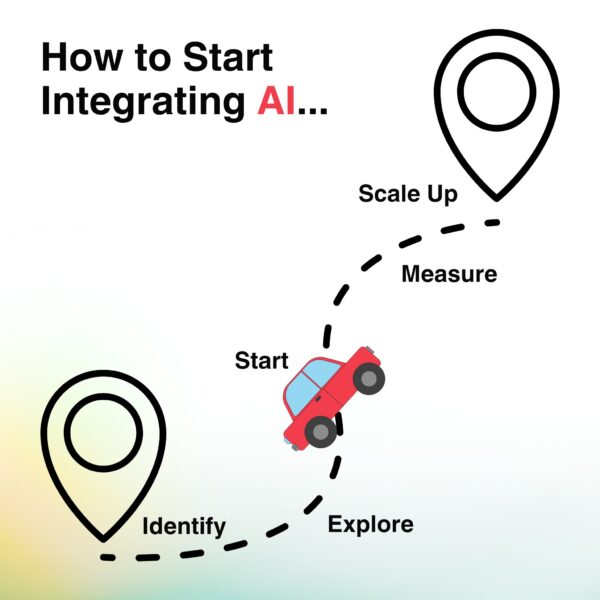
How to Start Integrating AI into Your Lead-Generation Strategy
Integrating AI into your lead-generation process doesn’t have to be overwhelming. Here’s how to make the transition smooth and effective:
Think of integrating AI into lead generation like selling your car to a buyer in another city:
You wouldn’t just jump in and drive off without a plan. First, you’d map out your route, tune up the car, and gather your paperwork. As you drive, you use navigation to dodge traffic and adjust your route if needed.But there’s more to consider: Every extra mile you put on the car reduces its value. Before you hit the road, you need to calculate; is it better to drive the car yourself, or should you hire a trucking company to deliver it? Maybe you use an app (like AI) to estimate the extra mileage, costs, and time involved. You weigh the options: Will the added wear and tear (and lost value) be worth it, or does investing in a professional service (like AI for your business) make more sense?
And just like you’d be transparent with the buyer about the car’s final mileage, you want to measure the impact at every step of your AI journey. Are you saving time, preserving value, and getting the results you want—or is it time to optimize your approach?
In both cases, it’s about planning, measuring, and choosing the smartest path to your goal.
- Identify the Most Impactful Areas:
Start by pinpointing where AI can deliver the greatest value—such as audience segmentation, automating email outreach, or improving lead scoring. - Explore the Right Tools:
Research and test AI-powered platforms that match your needs. Popular options include ChatGPT for content and conversation, Salesforce Einstein for CRM intelligence, and HubSpot’s AI-driven features for marketing automation. - Start Small:
Roll out AI in a single workflow or campaign. Track performance and user feedback to gauge impact. - Measure Results:
Use analytics to compare before-and-after outcomes—look for improvements in lead quality, response rates, and time saved. - Scale Up Strategically:
As you see success, expand AI adoption to other parts of your business development process. Continue to iterate and optimize as your team gains experience.
Implementing AI is a journey—one that starts with clear priorities and grows with each successful experiment.
AI-Powered Proposal Generation: Speed and Precision
Creating high-quality business proposals is daunting—research, collaboration, and endless revisions eat up valuable hours. AI-powered tools like Aurora Slides streamline this process, delivering speed, consistency, and impressive results.
Aurora Slides: Transforming Proposals into Persuasion
Aurora Slides empowers Business Development Directors to generate polished, client-specific proposals in hours—not days. By integrating client details, past interactions, and branded templates, Aurora ensures every proposal is accurate and tailored to client needs.
Check it out in action here:
Impact on Efficiency:
AI can automatically detect, pull answers, and fill out RFP responses, radically accelerating the speed at which sales and bid teams respond to an RFP—up to 70% time savings! Aurora Slides also transforms drafts into sleek, client-branded presentations, helping mid-size firms stand out.
Real-World Use Case: AI Streamlines Proposal Creation
A national marketing company faced the all-too-common challenge of balancing creative excellence with operational efficiency. While their team excelled in client work, key business operations—like tracking project milestones, managing contracts, and especially responding to RFPs—were labor-intensive and error-prone. Manual processes led to missed deadlines, last-minute scrambles, and unnecessary stress for senior leaders.
Seeking a better way, the company implemented an AI-powered document engineering solution. The platform intelligently analyzed and organized documents, automating contract management, surfacing project milestones, and even anticipating renewal deadlines. Most importantly, it enabled the team to generate tailored RFP responses quickly and consistently, using information already embedded in their archives.
The results?
- Seamless integration with existing workflows
- Faster, more accurate proposal creation
- Increased productivity and client satisfaction
- Less time spent on busywork, more time on strategic client pitching
Senior leaders could finally focus on high-value tasks—like winning new business—instead of wrestling with paperwork.
Real-World Application: Winning Proposals in Record Time
Imagine a mid-size firm responding to an urgent RFP from a high-profile client. Traditionally, this would take days of manual effort. With Aurora Slides, the process looks like this:
- RFP Uploaded to Aurora’s Client Workspace: All relevant information is consolidated instantly.
- SmartFlows for Drafting: Insights from past proposals and client data are integrated automatically.
- Aurora Slides for Finalization: The proposal is transformed into a sleek, client-branded format ready to impress.
Result:
Companies like Loopio report that 68% of proposal teams have now used generative AI in the past twelve months—twice as many as the previous year.
Data-Driven Decision-Making for Proactive Strategies
AI empowers Business Development Executives to make proactive decisions by synthesizing data from diverse sources—sales metrics, market research, competitor analysis, and more. This leads to agility and innovation, positioning teams to seize opportunities as they arise.
AI and Business Development in Action
According to Outreach.io, AI tools proactively identify account and deal risks, helping sellers close over 2 million opportunities every month. With features like Smart Account Assist and Smart Deal Assist, teams know exactly what’s happened recently and what steps to take next, adapting strategies in real time.
By leveraging AI, teams ensure decisions are backed by reliable data, aligning every move with market demands.

The Future of AI for Business Development
AI is no longer a luxury—it’s a necessity for staying competitive in today’s fast-paced environment. By automating lead qualification, generating tailored proposals, and delivering actionable insights, AI empowers business development leaders to operate with greater efficiency and strategic impact.
Organizations integrating tools like Aurora Slides unlock new levels of productivity, scalability, and innovation. Whether through hyper-personalized outreach, data-driven strategies, or streamlined workflows, AI is shaping the future of business development.
Embrace the Future with AI:
The future of business development is here, and AI is leading the charge. For Managers aiming to drive growth, improve efficiency, and deliver exceptional client experiences, tools like Aurora Slides and the others mentioned above; offer a clear path to success or at least a great start.
Ready to transform your approach to business development?
Start your free trial here.
Frequently Asked Questions (FAQs)
How does AI improve the quality of leads?
A: AI uses advanced algorithms to analyze customer data, behaviors, and preferences, ensuring that your leads are highly relevant and likely to convert. By identifying patterns and intent, AI targets the right audience with precision, reducing wasted effort on unqualified prospects.
Is AI-driven lead generation expensive to implement?
A: While there is an initial investment in AI tools and platforms, the long-term ROI often outweighs the cost. AI reduces time spent on manual tasks, improves targeting accuracy, and increases conversion rates, making it a cost-effective solution for businesses of all sizes.
Can AI help small businesses generate more leads?
A: Absolutely! AI levels the playing field by providing small businesses with access to advanced tools for audience targeting, personalized marketing, and predictive analytics. With AI, even smaller teams can achieve significant results in lead generation.
What are the best AI tools for business development?
A: Top platforms include Aurora Slides’ AI Deck Builder capabilities (for proposals and presentations), Outreach.io (for sales automation), QorusDocs (for RFP responses), and BuzzBoard (for lead intelligence).
How do I get started with AI for business development?
A: Begin by identifying your team’s most repetitive pain points—then pilot a tool like Aurora Slides or Outreach.io for a specific workflow. Measure results and scale up as you see ROI.
Is AI worth the investment for mid-size firms?
A: Absolutely. AI levels the playing field, allowing organizations of any size to access powerful automation, personalization, and insights that were once the domain of industry giants. What we do know as a fact is that larger organizations are further along the AI adoption journey; with 78% of respondents at agencies with more than 201 employees saying they leverage the tech compared to only 53% of small agencies.
How secure is my business data when using AI tools?
A: Choose vendors with clear data security policies, transparency, and compliance certifications. Most leading SaaS providers offer robust encryption and regular security audits.