

An “AI business” used to sound like something straight out of a sci-fi project, but not anymore! Let’s start with a shocking percentage of how since 2017 until last year, the amount of solo adventures has more than doubled in size. According to The European Business Review:
“35 percent of the U.S. startups incorporated in 2024 had a single founder.”
Why is this happening?
Well, it could be said, everyday that passes, founders are needing less and less to build their ideas.
For example, you don’t need a fancy degree or a crew of engineers to launch an AI-powered business nowadays. If you’ve ever thought, “Could I really do this solo?”– the answer is yes. Right now is the best time in history to go from idea to income, harnessing AI not as a buzzword but as your secret weapon.
This isn’t about hype. It’s about practical steps, honest lessons, and what actually works when you’re building alone, from scratch. By the end, you’ll know exactly how to create an AI business as a solo founder – no jargon, no gatekeeping.
“One-person AI startups are not a Silicon Valley myth – they’re happening everywhere, every day” – European Business Review

Before we dive deeper on how to build an AI business; I want to highlight a resource that’s helped thousands of new founders get unstuck and take action – fast. You might not have six spare hours to watch a YouTube masterclass right now (though it’s absolutely worth bookmarking for later).
So, let’s break down the most important lessons from the epic video “Build Your First AI Business in 6 Hours (Ultimate Beginner Guide)” – so you can grab the key insights in just a few minutes.
Build Your First AI Business in 6 Hours
If you want the big takeaways first, here’s what you need to know:
1. Business Fundamentals Matter More Than AI Hype
Nick, the host, stresses that building a successful AI business isn’t about being the best coder or having the fanciest tech. The real differentiators are business basics: lead generation, sales, and customer retention. Focus on solving real-world problems, not chasing shiny AI trends.
2. The AI Business Model Is Just… Business
The core funnel is universal: attract leads (cold email, referrals, paid ads), convert them via calls and proposals, deliver value, and retain clients. The only unique part is your fulfillment—using AI and automation to deliver results.
3. You Don’t Need to Be Technical—Leverage No-Code Tools
You can use platforms like Make.com, Zapier, and even APIs (with copy-paste templates) to build powerful automations. Don’t get stuck in technical weeds; use available tools to connect apps and create value.
4. Niche Down & Validate Fast
Pick 2–3 “boring” niches with real business pain points. Research their communities, find the headaches, and build simple AI automations that save them time or money. Don’t obsess over perfect ideas—act, test, and iterate.
5. Rapid Lead Generation & Outreach
Use cold email, Upwork, and niche communities to get your first clients. Scrape leads using tools like Apollo and Appify, personalize your outreach with AI-generated icebreakers, and track your stats to see what’s working.
6. Launch with an MVP, Iterate & Split Test
Don’t wait for perfect. Get your basic AI service out, collect feedback, split test your outreach and offers, and refine your product as you go.
7. Deliver Like a Pro (Even Solo)
Your onboarding, communication, and delivery process should feel professional—even if it’s just you behind the scenes. Use automation for follow-ups, send clear documentation, and always express gratitude to clients.
8. Retain & Upsell
After a job well done, use your relationship and results to upsell additional services or move clients onto recurring retainers. Your process should be a loop: deliver, document, impress, and repeat.
Watch the full video here:
Now let’s fully dive into the not so far away future…
The New Era of the Solo AI Founder
It’s not just hype—something fundamental has shifted in how ambitious people can build with technology. The days of needing a huge team or mountains of venture capital are giving way to a new reality: with the right tools and mindset, a single founder can move faster, automate more, and still build something remarkable. So what’s fueling this solo founder revolution?
Why One-Person AI Businesses Are Booming
Remember when launching a tech company meant raising stacks of cash and hiring a swarm of developers? Those days are fading—fast. These days, I see founders hitting six figures in monthly revenue, all by themselves, letting AI handle the grunt work. One guy I met at a remote work conference? He built a $100K/month SaaS on his kitchen table, automating customer support, onboarding, and even some sales emails with AI.
He’s not a unicorn – he’s part of a new herd: the “dupe unicorns.” These are lean, capital-efficient, AI-powered startups that are rewriting the rules, showing that you don’t need a boardroom or a big budget to make it. Wayne Liu, a Forbes Councils Member, states that:
“Recent research shows that AI startups are achieving revenue growth at a pace that significantly outpaces traditional tech companies. Their ability to reach customers faster, automate internal processes and scale with minimal human overhead gives them a notable advantage, especially in a market where efficient monetization has become a survival skill.”
Rethinking the Founder’s Role
As a solo founder, you’re not chained to every task.

You’re more like a conductor, waving the baton while AI “musicians” take care of the notes. Tools today let you delegate the repetitive, time-sucking work to software agents; think of it as hiring a team of tireless interns who never sleep, eat, or ask for health insurance. What sets successful solo founders apart is their willingness to experiment, fail fast, and orchestrate – not micromanage – every detail.
For example, you might have heard already about Autonomous Agents, and yes, according to Forbes that’s where this is headed:
“Advances in AI agentic systems, as conceptualized by OpenAI’s framework for autonomous agents, are enabling solo founders to achieve what once demanded entire teams. Welcome to the era of the “one-person unicorn,” where AI agents don’t just augment human effort—they redefine what’s possible for a single entrepreneur.”
Finding Your AI Business Idea
Before you start brainstorming features or picking the latest AI model, pause and take a step back. The most successful solo founders don’t begin with the tech—they start by zeroing in on a real, nagging problem that customers actually care about. It’s easy to get caught up in the excitement of new tools, but what really matters is solving a pain point that someone would pay to fix.
Start with a Real Problem, Not the Tech
If you have spent spent weeks obsessing over which AI model to use for a project; before realizing I hadn’t solved a real pain point. You’re not alone. There’s a founder who burned through $47K and 18 months building a product nobody wanted. This is just one of the mistakes he described in the full post:
“… What I Got Wrong (Pretty Much Everything)
1. I Built a Solution Looking for a Problem
Small businesses don’t actually want AI copywriting tools. They want customers. Big difference.
When I actually talked to my target market (should’ve done this first), here’s what I learned:
- They’re too busy to learn new tools
- They don’t trust AI for their brand voice
- They’d rather hire their neighbor’s kid for $50″ – r/Entrepreneur•Nipurn_1234
Lesson learned: Start by talking to real people. Look for those “boring” business headaches—like scheduling, compliance, or document review – that drive folks nuts.
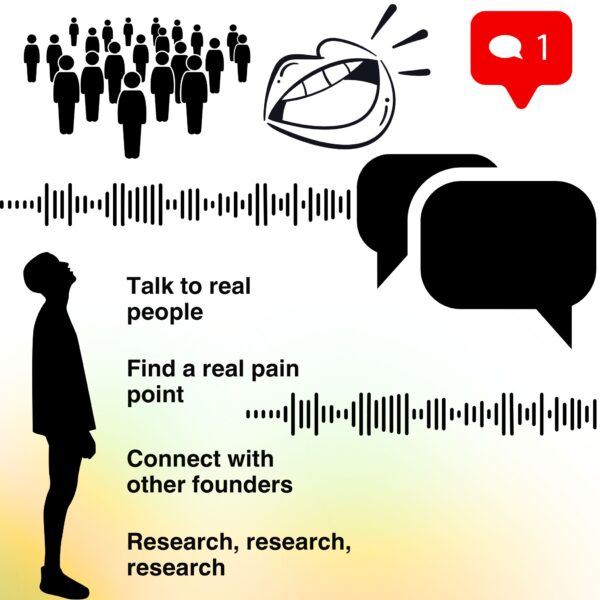
If you want to take this even more seriously; you should look for real-life stories of people that tried before you and contact them. Checkout the answer left under this Reddit Discussion below. These are goldmines for solo AI founders:
“What are some realistic AI/Generative AI business ideas with strong use cases?
Discussion
I’m participating in a business plan competition focused on innovative AI or Gen AI applications and looking for ideas that could actually work in real life. I want to explore use cases where AI can provide real value, whether by solving existing pain points, improving efficiency, or creating new opportunities etc.
If you’ve come across or thought of any unique yet viable ideas, I’d love to hear them ^
Bonus points if they aren’t just generic AI chatbots but have specific industry use cases
Thank youuu” – r/AI_Agents•Soggy-Priority-4187
A quick exercise: Next time you’re at a meetup or on a call, ask, “What’s the one task you wish you could automate or never do again?” That’s your starting line.
The Leveraged Agency Model
Manual → Automate → Scale. Don’t try to automate everything right away. The smartest founders start by delivering results manually—learning what clients really value and how the workflow plays out on the ground. Only then do they bring in AI and automation to handle repeatable tasks. Once your systems work, scale step by step.
This isn’t just a tactic—it’s the essence of bootstrapping. Bootstrapped founders build with their own resources, stay lean, and focus relentlessly on cash flow and customer feedback. The rewards? Full control, financial discipline, and a business built for profit and flexibility from day one. It’s not always easy, but the independence is worth it.
If you want proven strategies and real-world examples, check out the full blog Bootstrapping: Building a Business from the Ground Up by Data Overload, for step-by-step frameworks and inspiration. Here are some tips from it – if you’re in a rush:
Pro tips from leading bootstrappers:
- Validate before you build: Use pre-sales, waitlists, and actual customer interviews to prove demand before investing time or money.
- Start with a minimum viable offer (even if it’s a manual service, a template, or a single-feature product).
- Use free and discounted tools (like Notion, Canva, Zapier, Stripe) to run lean.
- Monetize early—charge for access, pre-orders, or subscriptions, and reinvest revenue to grow.
- Document your journey and build your audience in public; transparency builds trust and attracts early adopters, even before you automate.

Bootstrapping isn’t a fallback – it’s a strategic choice that lets you keep 100% equity, move at your own pace, and build a business on your terms. Whether you’re a first-time founder, student, or side-hustler, this model gives you the freedom to learn, iterate, and grow; without giving up control.
Launching Your AI-Powered MVP
Launching an AI product as a solopreneur might sound intimidating, but thanks to today’s ecosystem of no-code, low-code, and AI-driven platforms, you can go from idea to working prototype faster than ever before. Modern solopreneurs are juggling dozens of roles—marketer, designer, customer support, even bookkeeper—all at once. The secret to not drowning in busywork? Using AI tools as your “virtual teammates” to automate, streamline, and amplify your solo hustle.
As highlighted in this in-depth guide to the best AI tools for solopreneurs by Learn With Whiteboard, the latest tools aren’t just about flashy tech—they’re about making your everyday workload manageable, freeing you up to focus on strategy and creativity.
No-Code, Low-Code, and AI Tools for Solopreneurs
You don’t have to be a coder—or hire one. Solo founders in 2025 are building, launching, and scaling tech startups at a pace that was unthinkable just a few years ago. Thanks to AI, the solo route isn’t just viable – it’s becoming the norm. The share of new startups founded by individuals (without outside funding) has jumped from 22% in 2015 to 38% in 2024, as AI shrinks the gap between “team of one” and “team of twenty.”
Today’s founders are leveraging no-code AI platforms, automation, and virtual co-founders to handle everything from product development to sales—sometimes growing seven-figure businesses with no staff at all.
Essential AI and No-Code Tools (2025)
|
Tool
|
What It Does
|
Best For
|
Starter Cost
|
Key 2025 Feature or Benefit
|
|---|---|---|---|---|
|
Content creation, brainstorming, support
|
Writing, research, automation
|
Free / $20/mo
|
Plugins, code, content, chat
|
|
|
AI-powered design, images, branding
|
Graphics, social posts, branding
|
Free / $14.99/mo+
|
Text-to-image, templates, video
|
|
|
AI code generation, suggestions
|
Coding, MVP, automation
|
$10–$19/mo
|
AI agent for code, bug fixes
|
|
|
Workflow automation, app connections
|
Integrations, automation
|
Free / $9.99/mo+
|
5,000+ integrations, triggers
|
|
|
Docs, project management, AI writing
|
Knowledge base, docs, planning
|
Free / $8–$10/mo+
|
AI writing, databases, templates
|
|
|
AI-generated pitch decks & presentations
|
Sales, fundraising, client decks
|
Contact for pricing
|
Instant slides, live editing
|
|
|
No-code website & app building
|
Web/app MVP, landing pages
|
Free / $29/mo+
|
Drag & drop, hosting, CMS
|
|
|
AI bookkeeping, receipts, expenses
|
Finances, expense tracking
|
~$20/mo
|
Scan receipts to cloud, auto-categorize
|
|
|
AI meeting transcription & notes
|
Calls, meetings, lectures
|
Free / $16.99/mo+
|
Real-time notes, speaker ID
|
|
|
AI chatbot for customer support
|
Sales, lead gen, chatbots
|
Free / $29/mo+
|
AI chat, multichannel, CRM sync
|
Still skeptical? Here’s a real example: One founder’s stack ran their entire business – and hit $100K/month solo.
Some Advice…
Let’s be honest: It’s easy to overthink and overbuild. Many have made that mistake – spending weeks on features nobody used. Start small. Launch ugly and fast. Price higher than you think you “should” (you can always run a discount later). And please, don’t overpromise and don’t try to please everyone. The riches are in the niches.
A good motto to keep: “If you’re not a little embarrassed by your first version, you launched too late.”
Solo AI Business Models at a Glance
You’ve got your MVP. Now, how do you make money? Here’s a quick cheat sheet—based on what works for solo founders in the real world:
| Model | How It Works | Pros | Cons | Best For |
| Flat-rate/Subscription | Customers pay a set monthly or annual fee for access to features and support. | Predictable revenue. Easy to explain and sell. | May not capture high-usage customers’ value. Can be hard to scale price with usage. | SaaS tools, consumer apps, B2B basics |
| Usage-based | Customers are billed based on how much they use (e.g., per API call, per document processed). | Aligns price with value delivered. Scales with customer adoption. | Revenue can be unpredictable. More complex to implement (need tracking, billing, etc). | APIs, B2B services, integrations |
| Value-based | Pricing is tailored to the specific results your product/service delivers (e.g., % of revenue saved, time saved, business won). | Maximizes revenue per customer. Strong incentive for customer success and satisfaction. | Can require heavy sales/support. Must prove ROI and negotiate deals—more work per customer. | Enterprise, consulting, big-ticket AI |
Monetizing and Scaling Your AI Business
AI businesses work best when your pricing is simple, transparent, and matches how your customers use your product. But how do you choose? Here’s how each model plays out in real life:
- Flat-rate/subscription:
Scenario: You’ve built a SaaS tool for social media scheduling. Most users want unlimited posts and predictable monthly costs. A flat monthly subscription ($29/mo) is easy for them to budget—and for you, it means steady, recurring revenue. If your users are small businesses or creators who hate surprise charges, this is a win-win. - Usage-based:
Scenario: You offer an AI-powered document analysis API. A startup wants to process 50,000 documents one month and 5,000 the next. Usage-based billing means they only pay for what they use. This model is great if your customers’ needs fluctuate or you serve other developers who want to “pay as they grow.” - Value-based:
Scenario: You’ve built an AI that helps e-commerce stores recover abandoned carts. One client credits your tool for $100,000 in extra sales in a quarter. You charge a percentage of the revenue you help generate. This model works best when you can tie your product directly to a measurable business result and want to maximize upside with a smaller number of big clients.
Pro Tip:
Don’t be afraid to experiment! For example, one founder started with $9.99/month (flat-rate) and got lots of “tire-kickers”—but after raising her price, she saw fewer refunds and more serious customers.
Choose a model that matches your customers’ expectations and your growth goals. You can always evolve—many successful solo AI founders start with one approach and pivot as they learn what sticks.
Aurora Slides for Solo Founders
Picture this: It’s Sunday night. You’ve got a big pitch in the morning, and your “presentation” is a jumble of sticky notes, half-baked slides, and random ideas in your phone. Enter Aurora Slides.
You dump your notes—text, voice memos, whatever—into Aurora Slides. The AI whips up a clean, on-brand presentation in minutes. It’s not just pretty—it tells your story, highlights your value, and adapts to your style. Want to tweak your messaging? Just type, “Make this slide more persuasive,” and Aurora Slides updates it live.
Remember, these days, a solo founder can close their first five-figure client simply using AI. Now add to that the ability to generate unlimited pitch decks every time you need one. With the new technology available you can go from,
“I used to dread building decks. Now, I walk in with confidence, knowing my slides look pro—even when I’m running on two hours of sleep”.
Want a peek at how this works under the hood?
If you’re interested in learning more about Pitch Decks Essentials, or how to chose the best AI Deck Builder, feel free to explore our Leaning Vault.
Legal, Ethical, and Psychological Realities
As you venture deeper into solo entrepreneurship, it’s not just the technical challenges that matter. Navigating the legal, ethical, and even psychological realities of running an AI business is just as important as building your product. Let’s start with the legal and privacy essentials every AI startup needs to get right:
Legal and Privacy Essentials for AI Startups
Here’s the not-so-glamorous truth: ignoring legal stuff early can come back to bite you. Data privacy? Non-negotiable. Intellectual property? Protect your code, your brand, your secret sauce. Algorithmic bias? You’re responsible for what your AI does.
Don’t go it alone—find templates, join founder groups, and get a quick consult with a startup lawyer.
Start here:
- Continuum: Independent risk – advisory consultancy specialized on helping businesses that are embracing Web 3.0, blockchain and emerging technology.
- The Wipo Academy is a good start as well for intellectual property. Or you can start today by reading this document about Generative AI – Navigating Intellectual Property.
The Solo Founder’s Mindset
Solo doesn’t mean alone. The loneliest founders I know are the ones who try to do everything in the dark. Community is your safety net. Share your wins and your struggles. Most successful people have a board or advisors for a reason. Maybe they have found my best business ideas and sanity while being in groups, joining Twitter or Reddit threads, or by “building in public” circles. Confirmation Bias as a solo founder is also dangerous. See for instance, software engineer Alex Cook shared in his blog “Pitfalls of an AI-First Startup: A Solo Founder’s Take”:
“I was so in love with my idea, and even more dangerously so, in love with my “creative genius”, that I cuckooned myself from being challenged.”
If you’re feeling stuck, burnt out, or confused, always reach out to someone who might have spent some time in your position at some point in their career. Most solo founders are far more generous than you’d expect.
Going Solo with AI Is Like Climbing a Mountain
Let’s wrap with a story. Imagine your solo AI business journey as a climb up a wild, unpredictable mountain. You’ve got a robot mule—call it Aurora—the thing never gets tired. It carries your gear, clears the toughest paths, and powers you forward.
But the robot doesn’t know the weather, can’t see the storm clouds, and won’t warn you about a cliff edge. That’s where a seasoned human guide comes in. Maybe it’s a mentor, a consultant, or a friend who’s been in the trenches. They spot the shortcuts, the hidden dangers, and the detours that only come from experience.
Bottom line: AI will get you farther, faster—but a little human wisdom keeps you on the path and out of trouble. The best solo founders? They use both.

Conclusion & Takeaways
Here’s what I hope you remember:
- The solo AI founder isn’t a unicorn—it’s the new normal.
- Solve real problems, not just “cool” ones.
- Start simple, launch fast, and tweak as you go.
- Use the tools (like Aurora Slides!) to buy back your time and sanity.
- Community, mentors, and a bit of humility are as important as any algorithm.
Frequently Asked Questions (FAQs)
Can I really start an AI business without coding?
A: Absolutely. No-code and low-code tools are your ticket. But not only trust opinions online, do your own research for success stories that align with your idea or industry.
What are the best AI tools for solo founders?
A: Aurora Slides for creating the best investment deck you can. ChatGPT, Canva for design, Make.com for automations, GitHub Copilot—start with these or search for more options with reviews.
How do I price my AI product or service?
A: Test, raise, and listen to your customers. Don’t race to the bottom. When it comes to pricing models, a to a report by Emergence, a leading venture capital company, suggests these 5 top pricing models in the AI market; Flat Rate, Consumption, Value Based, No Plan to Monetize, and Other.
What legal issues should I watch out for?
A: Data, IP, breach risk, and bias. Get advice early.
How do I avoid solo founder burnout?
A: Find your people. Build in public. Ask for help. You can start small by joining the Reddit community r/startups, and finding discussions focused on AI Startups like this one “AI startup founders, what are you struggling with when it comes to your GTM strategy? (I will not promote)”
Ready to take the first step? Explore some of Aurora features to get started.