

Let’s face it: in the world of startups and fundraising, first impressions matter. And few things make or break that impression like your ability to explain your competition. Investors, partners, and even your own team want to know: do you really understand the field you’re playing in? A competitor analysis pitch deck isn’t just a slide for the sake of formality—it’s your opportunity to prove that you’ve done your homework and are ready to win. Another great point made by the British Business Bank is that:
“Investors may also be keen to understand how challenging it would be for rivals to copy your solution, so if you have any intellectual property it’s good to mention it, or detail what makes your product defensible.”
Always remember that investors want to see that founders have a clear grasp of who else is playing in the market, and what sets them apart. This guide will help you gain perspective about your competition and will provide you with clear steps to craft the perfect slides when referring to them.
Visit our Learning Vault for more insights on utilizing AI for business and Pitch Deck Essentials.

What is a Competitor Analysis Pitch Deck?
Before we dive into frameworks and visuals, let’s clarify what we’re talking about.
A competitor analysis pitch deck is a focused section – often a handful of slides within your fundraising deck—where you clearly present who your competitors are, how you compare, and what makes you different. It’s typically positioned after you’ve defined the problem and market, but before you unveil your solution or business model. This context helps investors see that your strategy is rooted in reality, not just in ambition. Also, as HubSpot points out in their blog:
“If an investor has little or no experience in your vertical, showing competitors they’re familiar with gives them real examples of success.”
For example; go through this real-life deck and HubSpot’s perspective on their competitor slides as to why they think it works:
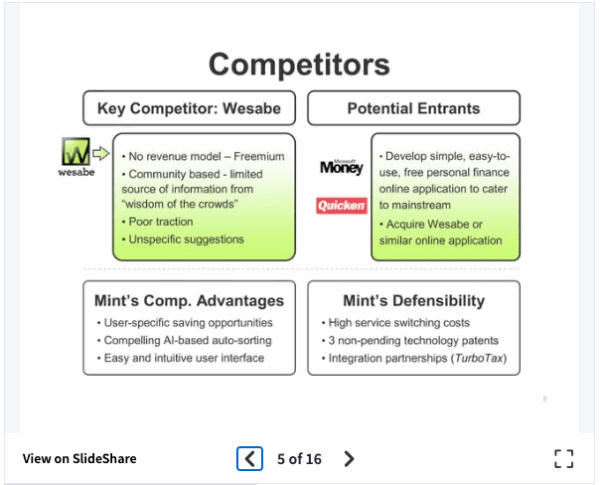
Why it works: Mint’s competitor slides are effective because they show current competitors along with future projections for these competitors. This slide effectively shows how Mint creates more value for customers over time and uses competitors as inspiration in their defensive strategy. – HubSpot
The Mint.com slide above is a perfect reminder: a strong competitor analysis pitch deck doesn’t just tick a box—it tells a clear, credible story about your market, your edge, and your vision for the future. By presenting your competitive landscape visually and honestly, you not only build trust with investors but also set the stage for why your solution truly stands out.
Why It Matters: The Strategic Imperative
You might wonder: “Do investors really care about the competition, or is it just expected as basic research?” The answer is a resounding yes; they care deeply. A well-crafted competitor analysis demonstrates that you’re not only aware of the risks but also able to articulate your unique edge. It’s about confidence, not arrogance. In fact, some founders have won over skeptical investors by being refreshingly honest about their competitive disadvantages and laying out a plan to overcome them. That kind of candor and strategy goes a long way.
When it comes to how to approach being honest while convincing; take a look at this amazing advice I found on the Reddit Thread r/startups. Someone started the convo by asking the following about how honest they should be to investors regarding their product being almost identical to competition:
Competition slide in Pitchdeck with similar competitor
byu/Heavy-Jeweler-3400 instartups
To which they got the following amazing replies:
- Focus on how you are going to compete instead on how similar your products are:
Comment
byu/Heavy-Jeweler-3400 from discussion
instartups
2. Don’t lie. Your investors probably understand the sector:
Comment
byu/Heavy-Jeweler-3400 from discussion
instartups
3. Use a 5-factor table matrix or learn more about the “Porter’s Five Forces”:
Comment
byu/Heavy-Jeweler-3400 from discussion
instartups
What’s striking in all this real-world advice is that the best competitor analysis isn’t about pretending you’re unique when you’re not; it’s about showing you understand the game and have a plan to win it. Investors are hungry for founders who are both honest about similarities and savvy about strategy.
As these Reddit threads prove, founders who acknowledge the realities of competition—and then confidently lay out how they’ll carve out their place; build far more trust than those who just spin minor differences. Avoid unrealistic projections, at all costs.
In the end, your competitor analysis isn’t just a slide; it’s your opportunity to show you’re realistic, resourceful, and ready to lead.
Step 1: Identify Your Competitive Landscape
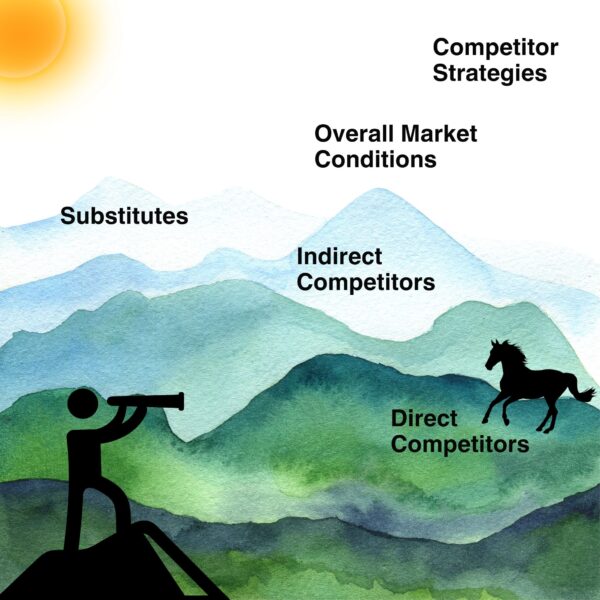
Now that you see why this matters, let’s get practical: how do you identify the right competitors? Start by mapping out the entire competitive landscape, not just the obvious rivals. This means thinking in layers:
- Direct competitors are businesses offering nearly identical solutions.
- Indirect competitors solve the same problem as you, but in different ways.
- Substitutes are alternative approaches that your target customers may use instead.
Here’s a quick table to help visualize this process:
| Name | Type | Description |
|---|---|---|
| Acme CRM | Direct | SaaS CRM for SMBs |
| Paper Planners | Indirect | Manual tracking, not digital |
| DIY Spreadsheets | Substitute | Google Sheets, Excel |
This approach ensures you don’t get caught off guard by a disruptive “dark horse.” For more on competitor categories and why this is critical, check out Whitepage Studio. In short, you need to be able to take strategic decisions based on real data and demonstrate you know how to interpret it in a way it gives you a competitive advantage.
Step 2: Gather and Validate Your Data
Once you have your list, it’s time to back it up with data. Assume that investors can spot guesswork a mile away. Quality research shows that you’re thorough and credible. Gather competitive intelligence from a variety of reputable sources:
- Public filings: SEC EDGAR, Yahoo! Finance, Bloomberg
- Review sites / Third-party resources: G2, Trustpilot
- Social media & forums: Reddit, LinkedIn Groups, ProductHunt.
- Direct engagement: Test out competitors’ products, sign up for their newsletters, request demos, attend trade shows, etc.
A competitive data source matrix can help you organize this information for quick reference. You can also go as far as gathering competitor financial data (it’s possible BTW). And remember; always cite your sources and keep your info up to date. Investors appreciate transparency, and a “last updated” note signals that you’re diligent.
Step 3: Analyze Using Proven Frameworks
With your data in hand, the next step is to make sense of it. Don’t just dump competitor names onto a slide – analyze them. The key to insight is using frameworks that make your findings clear, structured, and actionable.
Here are three that stand out:
- SWOT Analysis: Basically means the exercise of mapping out each competitor’s strengths, weaknesses, opportunities, and threats. These four; SWOT can be visualized in a matrix format.
- Porter’s Five Forces: Assess the competitive pressures in your industry.
We extracted the following from the video “Porter’s Five Forces: 3 Key Takeaways for Your Competitor Analysis Pitch Deck”- Understand the Five Pillars:
Porter’s Five Forces helps you break down your industry’s competitiveness by analyzing: the threat of new entrants, bargaining power of suppliers, bargaining power of buyers, threat of substitutes, and intensity of competitive rivalry. These forces shape your market’s profitability and reveal where your business can stand out. - Apply with Real-World Context:
Use real examples – like Apple shaking up music distribution or McDonald’s and Burger King’s ongoing rivalry – to make your analysis relatable and credible. Show investors you know how these forces play out in your specific market, not just in theory. - Turn Insights into Strategy:
Don’t stop at identifying the forces. Use your findings to craft practical strategies – whether that’s building barriers to entry, negotiating better supplier terms, or highlighting your differentiated value. The real power of this framework is in showing how you’ll leverage it to win.
- Understand the Five Pillars:
- Perceptual Mapping (2×2 competitive matrix): Plot your position versus competitors along two key dimensions (e.g., price vs. features).
Whitepage Studio
If you want to hit the ground running, you can use a ready-made competitive analysis template or download a free competitor analysis template.
Or if you want a deeper dive and more examples? Watch the full Youtube video here:
Step 4: Crafting Your Competitors Slide
Now comes the creative part—turning your research into a compelling visual story. The competitors slide is where you bring data and narrative together. There are several tried-and-true formats:
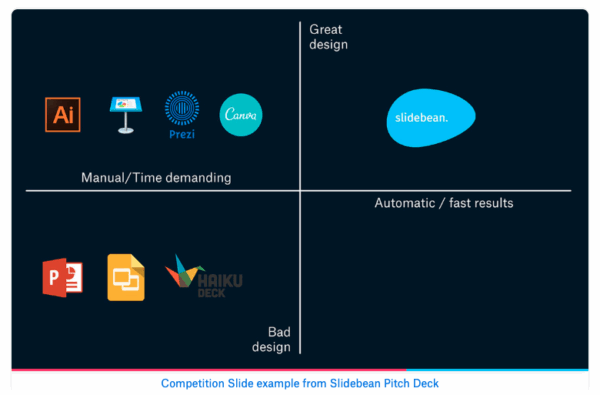
- 2×2 competitive matrix: Quickly shows how you stand out on two critical axes. And generally, you will be expected to define at least the two most relevant differentiators in your industry
Here’s a real-life example from a Slidebean presentation:
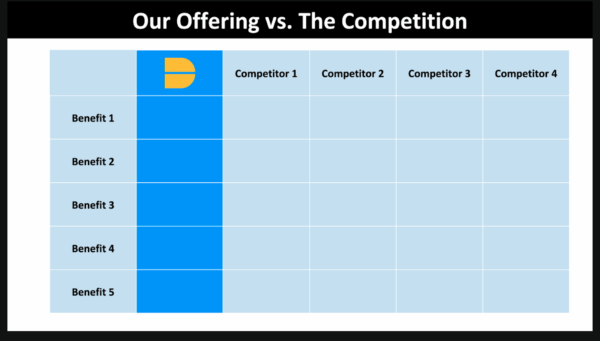
- Power Grid / Comparison Table: Great for listing features, prices, or focus areas
Here’s what a Power Grid looks like:
- Petal Diagram: Useful for demonstrating overlaps and market ecosystems.
Here’s what Steve Blank’s Petal Diagram looks like:
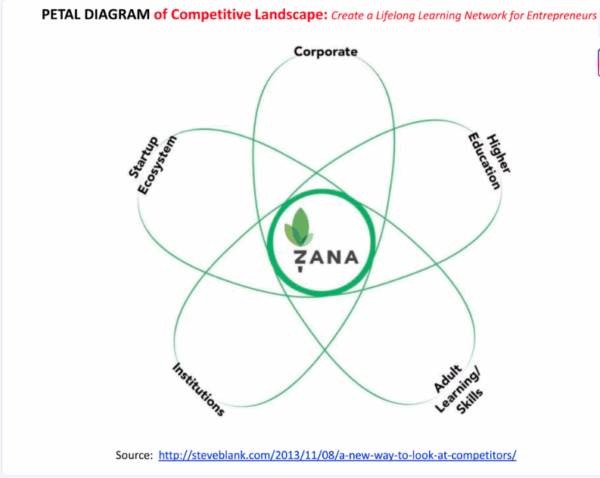
Here’s a quick comparison of all three:
| Visual Type | Pros | Cons |
|---|---|---|
| 2×2 Matrix | Visual, intuitive | Can oversimplify |
| Comparison Table | Detailed, specific | May become crowded |
| Petal Diagram | Shows relationships | Less common, harder to read |
For more inspiration and examples, see Basetemplates.
Pro tip: Never disparage your competitors; investors see through this and may question your professionalism. A good competitor analysis and a good product will be enough for you to prove your business idea!
Step 5: Tell the Strategic Story (The “So What?” Slide)
After all the visuals and analysis, the real magic is in your narrative. The “So What?” slide addresses the elephant in the room: why should anyone care? This is where you tie your competitive insights back to your unique value proposition and show how you’re positioned to win.
Lay out, in plain language, what makes your approach defensible and different. For example:
- Our AI-powered onboarding with Aurora (for example) reduces setup time by 80%
- Only solution with direct integration to X
- Patented technology in progress
- We already have built a network of providers
- Starbucks already made an offer for our coffee beans because of quality + low cost
- The Gluten Free market in Argentina just keeps growing and no big competitors have established themselves
The best competitor slides don’t just list features – they show your strategic advantage that most of the time you can share through a story utilizing real facts, real data, or real percentages. For more guidance on telling your story, check out VIP Graphics.

Step 6: Common Mistakes to Avoid
It’s easy to stumble here, even if you’re well-prepared. Avoid these common errors:
- Claiming “no competition”—this always raises red flags.
- Feature or information overload—cramming every possible detail into a table can overwhelm and distract.
- Negativity or “winner-takes-all” narrative—speaking poorly of competitors backfires.
A quick review before you present can help you catch these. For more good examples to follow, see Basetemplates.
How to Simplify Competitor Analysis Slides
If building a competitor analysis deck still feels daunting – especially when it comes to design – you’re not alone. This is where Aurora Slides shines. Aurora Slides uses AI to turn your notes, research, or even messy documents into clean, professional slides in minutes. No design degree required.
You can instantly:
- Apply designer templates and layouts for competitors, 2×2 matrices, and comparison tables.
- Edit content and visuals conversationally, so your slides always match your message.
- Empower anyone on your team to create a compelling, strategic deck—without the friction.
Curious to see it in action? Check out our Aurora LinkedIn profile for more fun posts like this one:
Quickly review this blog to see more options for Investment Deck AI Generator with real reviews and comparison tables.
Step 7: Templates, Resources, and Further Reading
Ready to build your own competitor analysis pitch deck? Don’t start from scratch—there are plenty of excellent resources and templates to help you get started:
- Free competitor analysis template (Basetemplates)
- Competitive analysis template (Ellty)
- Pitch deck examples and guides (HubSpot)
- Competitor analysis basics (Coursera)
Navigating Startup Success with Real-Time Maps
Imagine building your startup is like planning a cross-country road trip. Years ago, you might have relied on a paper map and a compass – helpful, but limited. Today, you’d never set out without a navigation app like Waze or Google Maps. Why? Because these apps don’t just show the roads—they give you real-time updates on hidden traffic cameras, speed traps, construction zones, accidents, and even the fastest detours, all reported live by other drivers.
Competitor analysis in 2025 is no different. Gone are the days when you had to guess what your rivals were up to. Now, every move; product launches, pricing changes, customer reviews, funding rounds – is publicly available, often reported in real time by users, analysts, or even competitors themselves. You can see who hit a traffic jam, who took a shortcut, and where the hidden pitfalls are.
Just like with Waze, your competitor analysis pitch deck isn’t just about finding the route; it’s about seeing the whole landscape, learning from others’ journeys, and avoiding costly mistakes. In this era, there are no excuses for flying blind.
If you use the tools; AI for small business, and information already out there, you can reach your goals faster, avoid the traps, and show investors you’re not just a driver – you’re a navigator ready for anything the road throws your way.
Conclusion & Key Takeaways
In the end, a strong competitor analysis pitch deck is about more than just checking a box. It’s your way to show that you “get it”; that you see the landscape clearly, can spot both threats and opportunities, and have a plan to win.
Just like using a real-time navigation app for a cross-country journey, your pitch deck should demonstrate that you’re not traveling blind; you’re leveraging every available resource to chart the smartest, safest, and most strategic route.
Here’s what to remember:
- Map your competitive landscape thoroughly
- Source and validate your data
- Use proven frameworks to analyze and communicate clearly
- Tell a strategic story that highlights your unique position
With all the AI tools and data available in 2025, there’s no reason to make your journey harder than it has to be. Show investors you’re the navigator with the best map – and you’ll be far ahead of the pack.
Frequently Asked Questions (FAQs)
How do I find my real competitors?
A: Use a mix of search, review sites, and direct product testing.
What frameworks should I use for my competitors slide?
A: SWOT, Porter’s Five Forces, and the 2×2 competitive matrix are most common. You could also explore the Growth Share Matrix as a slide to include.
Can I use a free template for my analysis?
A: Yes! Check out Basetemplates or Ellty. Or if you’d like to start with a prompt and not have to worry about the visuals, test Aurora Slides – AI deck builder powers…
How honest should I be about my competitors’ strengths?
A: Be candid and strategic; investors appreciate honesty and insight over bravado. And if your competitors are actually strong in the market, not acknowledging this is also a mistake.
How can Aurora Slides help me build a competitor analysis pitch deck?
A: Aurora Slides uses AI to turn your notes, research, or even rough outlines into polished, professional pitch deck slides – including competitors slides, 2×2 matrices, and comparison tables. You don’t need design skills or advanced formatting – just focus on your insights, and Aurora Slides will organize and style your information for maximum impact.
It’s perfect for founders or teams who want a fast, effective way to showcase their competitive landscape visually and persuasively.
Any additional advice for my competitors pitch deck?
A: It’s almost 2026… Consider integrating AI Adoption as a whole in your company or processes from the start. If you mention this as part of your strategy investors might perceive your product/business launch a little bit more likely to survive in the market – no matter which market.
When it comes to your competitors you could mention you are almost sure they are not utilizing AI in their processes to ensure the model being future-proof.